



Marketing
The White Bunny
How the small things make the biggest difference in life, love, and business, plus why microcopy is actually a big thing.

In the webinar “What’s the “Big Idea?” Key Trends in Marketing — and Where AI Fits In” moderated by Ann Handley, Salesforce’s very human Martin Kihn discussed “big ideas” for marketers to consider this year. And Taylor Swift.
Here’s a brief summary and some notes on the key trends in marketing in 2024:
The difference between B2B and B2C is the approach to data itself. Account object vs a person. But of course, B2C, B2B, DTC, B2B2C and combinations thereof, are all ultimately B2P. Business to people.
Companies are expected to engage through digital channels, and to do so in an entertaining way. The key is being recognizable, having a story, a narrative, and good, personal, polished content. Best performing B2B brands are very approachable, their videos are clear, their copy is simple and straightforward.
Now that the robot learns how to write, we don’t want to read anymore. From the super text-heavy 90s Internet to the current TikTok effect which is also a design trend, we have reached the age of the post verbal consumer.
80% of customers will drop a brand after three friction strikes. 30% won’t even wait that long. Couple of things to watch out for: slow page load times and checkout issues.
There are more differences between demographic cohorts than between them. Cf Australian Lamb, also dispeling the Generation Gap myth by focusing on what different generations have in common.
And everywhere else, according to Gregory House, but that’s more or less the idea. Surveys can’t really be trusted. We don’t answer what we really think but what we’d like to think, what we think people will like or react better to. Therefore, surveys should be taken with at least a pinch of salt and marketers must focus on seeing what people do, not so much what they say.
2024 is the death of the cookie, but no one knows the difference or implications of first vs third party cookies. And that leads to paranoia. People have been increasingly interested in searching the concept of “tracking”, which peaked in 2018 during the hearings in the Cambridge Analytica mess.
Speaking about that, the privacy paradox is very real. It’s a disconnection between what people say about their data and what they do about it, and we can look back to 2018 when Apple decided to become the neighborhood watch of the Internet and embraced the opt-in, with Google following suit. How can we decide to opt in or out of an experience we haven’t had yet? It seems the trick to solve the paradox is popularity.
The higher level of trust, the more satisfied customers are with the brand. Trust is correlated with satisfaction, and so is ease of use.
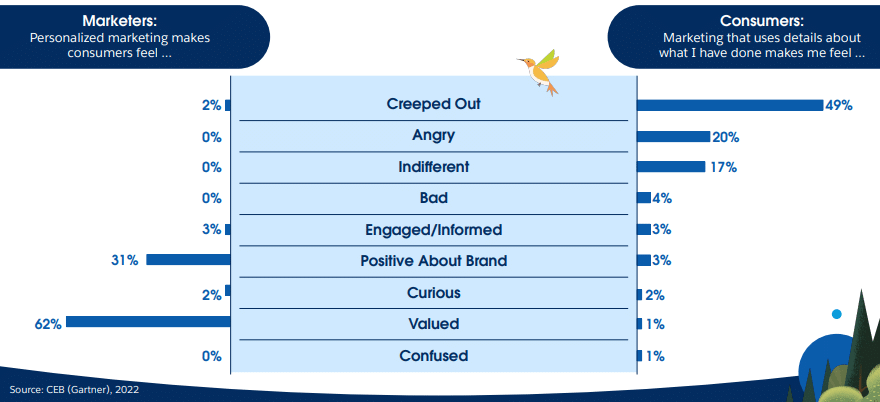
Perhaps she is not your wife, as David Ogilvy said, but the consumer is definitely not YOU. In the Holy Name of Mark Ritson, may this be the year when marketers finally realize most people are creeped out, or at best, uninterested in what we tend to consider super cool personalized marketing.
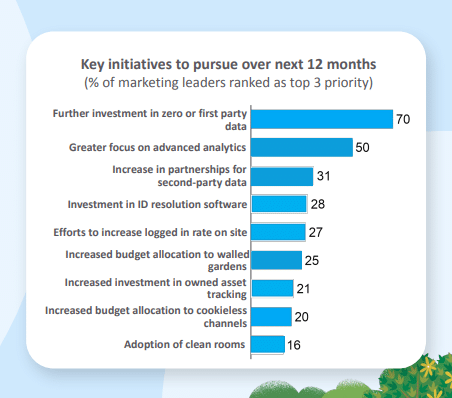
Where your analytics are. The best marketing investment is analytics. You can get a higher ROI than in other areas for spending in Analytics, including talent, tools, processes and partnerships.
It does change things. And it requires change too. Marketers need to get better at being precise and asking good questions well. Minor changes in the prompt can lead to major changes in the output. Key word: refining.
LLMs are commodities that need refinement because anything available to your competitors is not a source of competitive differentiation. So the thing is to train these powerful models on something your competitors don’t have, such as your first party, company data.
Consumer product companies don’t usually have 1PD, as retailers are the ones engaging with clients. The good secret is the 1PD doesn’t have to be your own.
And data needs to be organized to be useful. What is everyone else doing? Investing on this.
And finally, a lesson from Taylor Swift, a massively successful brand among very diverse groups of people.
Martin’s online survey revealed 80% of people either love her, like her or are warmly indifferent to her, whereas 20% said they did not like her. The follow up questions for that 20% had to do with their feelings and state of mind, 80% of whom revealed they were not happy. The conclusion is that people who hate Taylor Swift hate life.
The secret of her success is that people project themselves onto her. Everyone can see in her what they want. This also applies to big companies and brands and possibly explains why cats ‑with constant resting cat face- still rule the Internet.

How the small things make the biggest difference in life, love, and business, plus why microcopy is actually a big thing.

AI is forcing marketers to work smarter. Learn how to optimize for robots without losing your audience and why small efforts now mean big wins later.

Discover why following trends can lead to bad choices. How to measure truth and make bold choices for true differentiation over repetitioning

Finding the (middle) ground in the hot air and embracing contradiction to navigate these very exciting - and very stupid - times.


