


Marketing
The White Bunny
How the small things make the biggest difference in life, love, and business, plus why microcopy is actually a big thing.
Once upon a time, there was an audacious, albeit dangerous tribe whose leaders would give what their predecessors had discovered earlier a sloppy spin, and proceed to claim they had invented it themselves: The Marketeers. We bring you: Marketing Storytelling vs Bull.
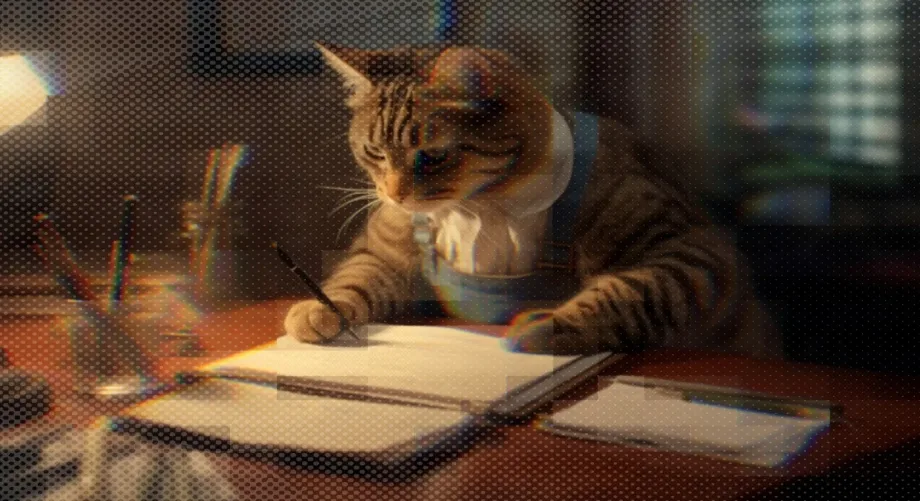
It felt right. It felt like the truth. Or “a truth”, anyway. Do you think it will happen?
The Sandman: A Dream Of A Thousand CatsMany business and marketing legends have spent the past two decades sowing the idea that a good story is and should be the absolute essence of marketing. Problematic, to say the least. Putting stories above everything else can very easily lead to convincing nonsense (drinking canned water will never be counterculture), bold technophile Ponzi schemes (hi Crypto!), and really successful failures (WeWork-ed). All these are examples of fantastic storytelling marketing used to conceal empty and purposeless endeavors.
Putting the truth (or a truth, an honest attempt at truth) first is harder, but it stands the test of time. First the walk, then the talk.
Stories are mighty. But we can do even better.
What you tell, and how you tell it, is just one more item in a long checklist. Business and marketing storytelling are tied to culture, purpose, product, quality, pricing, design (how it looks, how it works, what it solves), scale, economics, idiosyncrasy, and zeitgeist. And if you run an honest business at the core, the truth will effortlessly show itself as a combination of all of those elements.
That’s how stories are undeniably powerful. They design the very essence of what human means.
And of course, stories can drive sales too. Finding clues as to how this works is the humble focus of this issue. Exploring how to write more, better, design better brands, and achieve goals through the endless magic of storytelling. Without the bull.
And they all lived happily ever after.
Let’s get to it.
“Framing” refers to the way we present and express information to the audience. It’s a way to pre-set a cognitive bias.(Rational Choice and the Framing of Decisions, Kahneman, Tversky, 1986).
Presenting an idea in one way or its opposite (think glass half-full or half-empty), can drastically change the way people perceive your brand, and whether or not your customers will choose you over your competitors.
Avis had a humble second place in its industry, unable to match Hertz. They reframed customer perception from “we’re not enough” to “we try harder”. Their legendary campaign was an instant hit.
Think hard about how you can turn your constraints, quirks, and less-known talents around and into clear and catchy ideas that stick and persuade.
Voice and tone consistency will remain one of the biggest challenges for generative AI (at least if you aim at originality). Whether you’re relying on a brilliant team of humans or cutting-edge technology, you need to communicate in a way that resonates with your audience.
If you read your stories out loud to a customer, do they get it? Does it sound like you get it? Does it reflect your team, purpose, experiences, and personality?
Consistency will make it easy for you and your team to create an entire body of content. Find some time to write a simple document setting basic guidelines:
Mailchimp’s Content Style Guide is a great place to start if you want to see a working example. More good stuff here.
Take the road less traveled. Try different approaches and see what makes people smile, feel surprised, and relate your brand to a good experience.
Lev Tanju’s minimal, irreverent, and unexpected copywriting skills make Palace Skateboards products instant memes. And a book even.
More cool ideas from Firebox.
Choose the proper combination of promise, rhythm, images, headlines, influencers, punchlines, and excitement to create an engaging lifestyle narrative.
Stellar examples include Dollar Shave Club ads, J Peterman’s flamboyant product descriptions, and the landing pages from our clients at Shimoda or YETI.
(Sidenote: The excellent storytelling on storytelling by Peterman himself).
Test-drive things. Sit down with your customers and understand how they perceive your brand. Try out new styles of storytelling with them and see how they react. In this data-driven era, we sometimes forget the unpredictable human factor and how easy it is to see if an idea will stick.
This short presentation by Clayton Christensen is a perfect example.
Persuasive copywriting, neuromarketing, and deceiving disruption are very powerful and tempting tools. These can make a brand grow, but the only way to stand the test of time is through honest ideas and a real intent to benefit your customers. Tell the truth and make sure it sounds believable. It’s a tragedy to be honest and have no one noticing it, right?
Smarter people saying this better:
Cliffhangers are not just for movies, you know?
Writing for a brand means finding ways to keep your customers happy, and coming back. Use smart, playful, delightful calls to action. Invite your readers to comment and interact (there’s a comment box at the end of this, btw) and invite them to keep dancing with your brand.
We have seven more storytelling tips in the works 😏.
Will you miss what’s coming? Or will you subscribe to read it first?
Lovely stuff we researched that didn’t fit the main article:
If this isn’t nice, we don’t know what is.
Time for some shameless autobombo, agency, and partner news.
Our marketing sprints can get your brand narrative up and running in 90 days. Contact us and let’s chat. It’s free.
RuckusWait, what? Of course we can help you shape your story!
Our marketing sprints can get your brand narrative up and running in 90 days. Contact us and let’s chat. It’s free.
Assorted stats for your catmusing. Most of them are not fake.
Stories are better if they’re well-written. We’ll be back in a month to talk all things #copywriting. Using words, tools, tricks, and frameworks to create content that stands out and doesn’t look like the AI subpar crap everyone’s spamming us with.
So long, and thanks for all the fish.
💟, 🍵4️⃣2️⃣

How the small things make the biggest difference in life, love, and business, plus why microcopy is actually a big thing.

AI is forcing marketers to work smarter. Learn how to optimize for robots without losing your audience and why small efforts now mean big wins later.
Discover why following trends can lead to bad choices. How to measure truth and make bold choices for true differentiation over repetitioning
Everything changes all time, except for the fact that the best way to understand and motivate customers is to focus on reality.


