



Marketing
The Attract Framework
Neglect the bots and your business becomes invisible, like the proverbial tree that falls in the forest but no one hears.
So yet another year of “constant change” and “evolving landscapes”, uh? Sounds like quite the permanent thing, change. It also applies to ecommerce trends.

It is true, the ecommerce landscape continues to evolve constantly, with new trends emerging that shape the way businesses talk to their customers and the way consumers interact with online brands. For a business, staying up to date with the latest trends isn’t just nice to have, but a must. With all the new tech and changes in what people want, staying on top of key e‑commerce trends means you can improve your offering, explore new chances to grow, and make (a bit more) sense of the online world’s tricks, and treats.
What is everyone else doing and why? What will the next “big thing” be? Which of the many new trends are worth following? We’ll get to all that.
But first, a word of warning to save yourself some valuable time: Perhaps you don’t need to follow all of them. It is highly unlikely that you won’t need to follow or care about any of them, though. With so much to stay on top of, more than learning about every possible trend under the sun, the best thing is to know enough about them to know which to ignore.
Wisdom is figuring out what doesn’t work and then avoiding it.
Shane Parrish
In this post, we will share some wisdom and cover the most significant current and future trends in ecommerce. Even if you are not planning to follow any of these trends in particular, it cannot hurt to know what is going on, and what is likely to happen soon.
Which are the current ‑and upcoming- trends in ecommerce? Well, the first one would have to be growth. According to Statista, in 2023, global retail e‑commerce sales reached $5.8 trillion. They are expected to grow by 39%, reaching $8 trillion by 2027.
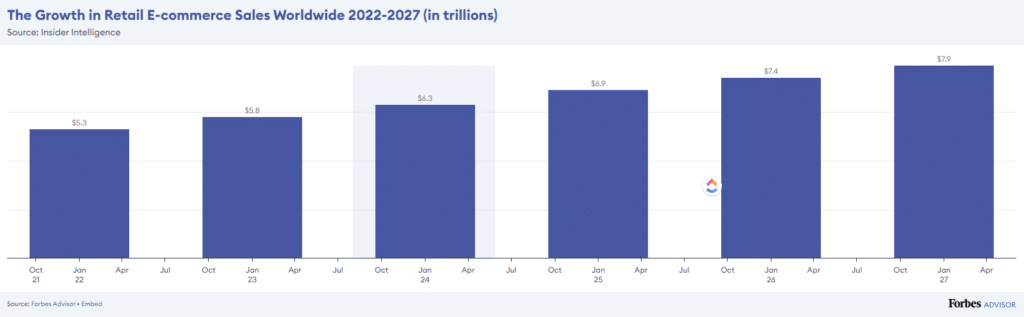
This growth is driven by a variety of factors, including the acceleration of the digital transformation prompted by the pandemic, and the rise of online marketplaces such as eBay, Amazon, or JD, which accounted for over one-third of global online shopping orders.In addition, advancements in technology, increased internet and smartphone penetration, and shifting consumer behavior towards online shopping have contributed to this upward trend.
Not a bad growth trajectory at all. After all, it’s only been a few decades, right? Here’s the story.
The history of global ecommerce naturally begins with the Internet, opened to the public in 1991. As soon as 1992, Charles M. Stack launched an online bookstore that operated as a dial-up bulletin board and, in 1994, became Books.com. Two other things happened in 1994.
First, Netscape created an encryption certificate that provided a means to transmit data safely over the Internet, SSL, so web browsers could determine if a site could be trusted. And someone bought Sting’s CD Ten Summoner’s Tales in a platform called NetMarket, described by The New York Times as “a new venture that is the equivalent of a shopping mall in cyberspace”, in the first recognized online transaction.
Then came an online bookstore and digital auction house that would later morph into ecommerce giant marketplace platforms, Amazon and eBay. The shift in consumer behavior was taking place, and trust in online purchases was strengthening, after the burst of the dotcom bubble, which had led to significant investment in internet companies, including ecommerce, and despite having helped lay some groundwork for the ecommerce industry, didn’t really do a lot of good in terms of people’s trust in new media and internet transactions.
The 2000s introduced us to smartphones, devices that would further transform ecommerce by unshackling it from desktop computers. Alongside with more accessible Internet, thanks to broadband and mobile, shopping became an anywhere, anytime activity.
In the 2010s, platforms like Facebook or Instagram began integrating shopping features, enabling direct purchases through social networks. This trend bridged the gap between social engagement and online shopping. User-generated content, like reviews and unboxing videos, began shaping buying habits.
In the 2020s, mobile commerce exploded, making it easier than ever to shop on the go, significantly expanding the potential customer base for online retailers. Apps became a critical part of the ecommerce ecosystem, with companies vying for a spot on consumers’ devices.
Big data analytics allowed businesses to offer personalized shopping experiences, predicting what customers might like even before they knew themselves. Omnichannel retailing blurred the lines between online and offline shopping, offering customers the seamless shopping experience they have learned to prefer and expect.
The COVID-19 pandemic catalyzed unprecedented growth in eCommerce, compressing years of digital transformation into a few months. Lockdowns and social distancing measures drove consumers online, with businesses, including B2B, rapidly adapting to digital-first models.
And this brings us to today. As you can see, ecommerce trends catch on and spread quite quickly. They have not only spurred growth in the ecommerce sector, but also fueled economic activity across multiple industries. and they usually algo como que they build on from the next?
The first trend is growth. It began and never stopped. The second has to be hybrid. This kind of Hybrid.
Hybrid Commerce (disambiguation)
Hybrid here means “the integration of digital and physical retail channels to create a cohesive and immersive shopping experience. In other words, Hybrid Commerce is the combination of online and offline shopping. Although online shopping has experienced and will continue to experience a massive growth, physical in-store experiences aren’t going anywhere for now.
Most of the key trends in ecommerce involve this integration in one way or another because the lines between online and offline are increasingly blurry, as consumers live in both spaces simultaneously.
As we noted before, hybrid commerce includes an experience of seamless integration across several shopping channels, known as Omnichannel.
The Latin prefix “omni” means “everything,” and Omnichannel refers to a sales strategy that allows consumers to interact with a brand across multiple channels: website, social media, email, physical stores and more. The superpower of Omnichannel is that it allows channels to talk to each other. That is, a customer can start shopping online and finish in a physical store or research a product on the phone and then buy it from the computer – all while maintaining the same shopping cart and customer experience.
Customers want a consistent experience across websites, mobile apps, and brick-and-mortar stores. That’s what omnichannel allows.
STAT: Omnichannel retailers retain 91% more customers than single-channel stores.
Social Commerce, the combination of social media browsing with instant purchasing options, is a rapidly growing facet of hybrid commerce, and a strong ecommerce trend. Platforms like Instagram and Facebook allow users to purchase products directly through their apps and this integration capitalizes on the user’s social experience, tapping into impulse buys and peer recommendations.
The current trend in social commerce involves features that allow direct purchases from social media posts and live shopping events that combine entertainment with instant purchasing options, such as Live shopping, shoppable photos and videos, shoppable ads and integrated checkouts.
STAT: 27% of consumers prefer to discover new products through social media over any other channel.
Customers click to order online and then pick up their purchases at a physical location. Also known as BOPIS (Buy Online, Pick-up In Store), these services allow customers to order online and pick up purchases at a physical location, reducing shipping costs and wait times for customers and also bringing more people to stores, with an extra opportunity to upsell or cross-sell products at pickup.
Like BOPIS, ROPO (research online, purchase offline) allows customers to choose where to research for a product, where to buy it, and where to get it. Both ROPO and BOPIS require trackable data and advanced analytics to map out customer journeys and scale services to offer customers what they need, where they need it, quickly and effortlessly.
STAT: Click-and-collect represented 19.5% of multichannel e‑commerce sales in 2022.
The journey of mobile ecommerce, or m‑commerce, began in the late 1990s with the advent of the first mobile-internet enabled phone. However, it wasn’t until the launch of smartphones and the subsequent development of responsive web design that mobile shopping started to gain real momentum. Key milestones include the introduction of Apple’s iPhone in 2007, which revolutionized how consumers interact with mobile devices, and the creation of mobile payment systems like Apple Pay and Google Pay, which transformed the checkout process, significantly reducing friction and abandonment rates, not only streamlining transactions but also offering enhanced security features, encouraging more consumers to shop on their mobile devices.
The shift towards a mobile-first approach in ecommerce is undeniable. With an overwhelming majority of consumers making purchases on their smartphones, optimizing for mobile is paramount. This means not only adopting responsive design to ensure the website is accessible and user-friendly across all devices but also simplifying the checkout process with mobile-friendly payment options. The biggest challenges include ensuring optimal mobile site speed, providing a seamless and intuitive user experience, securing transactions, and staying updated with the latest mobile commerce trends and technologies.
The rollout of 5G networks promises to significantly improve mobile ecommerce through enhanced speed and connectivity. This advancement will enable more complex and interactive mobile shopping experiences, reducing loading times and improving user satisfaction.
STAT: Mobile commerce sales are expected to account for 62% of all retail sales by 2027.
Hype and panic aside, Artificial Intelligence (AI) and automation are no longer buzzwords but necessities in the ecommerce landscape. AI is here to stay and will inevitably remain a key ecommerce trend for the next few years in two main areas: personalization and automation.
From personalized product recommendations powered by machine learning algorithms to automated customer service via chatbots, AI enhances the shopping experience by making it more relevant, fast, and convenient. This not only increases customer satisfaction but also boosts sales and loyalty. The key to AI’s effectiveness lies in its ability to learn from data, meaning the more it’s used, the better it gets at predicting and meeting customer needs.
Retailers are now utilizing AI to personalize shopping experiences by analyzing customer data, optimize operations from supply chain logistics to inventory management, and enhance marketing efforts with AI’s predictive capabilities that enable retailers to target customers more accurately, improving marketing ROI.
Implementing any new technology does not come without its risks and challenges. Make sure you explore those risks and understand them to use the technology as a tool, not an end in itself.
Ecommerce design trends are more than just fleeting fads. They represent the evolving expectations of consumers and the innovative technologies shaping the industry. Staying ahead of these trends is crucial for any ecommerce business looking to thrive in a competitive market. It’s not just about aesthetics; it’s about creating an engaging, intuitive, and seamless shopping experience.
Gone are the days of cluttered websites. Today, minimalism reigns supreme, emphasizing clean lines, ample white space, and a focus on essential elements. This shift not only enhances the visual appeal but also improves usability and load times. Simplicity is key in modern ecommerce design. Minimalist interfaces prioritize content and functionality, removing unnecessary distractions and focusing on the user’s journey.
As we mentioned earlier, with the majority of internet users accessing the web via mobile devices, mobile-friendly design is no longer optional. Responsive design ensures that ecommerce sites look and function perfectly across all devices, providing a consistent shopping experience.
Ecommerce sites are becoming more dynamic, adapting content and layout in real time based on user behavior. This personal touch enhances the shopping experience and can lead to higher conversion rates.
Ecommerce design trends are continually evolving, driven by changes in consumer behavior, technology advancements, and the never-ending quest for a better user experience. By embracing these trends, ecommerce businesses can create compelling, user-friendly platforms that not only attract but also retain customers.
Although there are several key differences between B2B and B2C ecommerce design, the key principles remain. If you’re interested, you can read our article about trends in B2B ecommerce design.
2020 propelled ecommerce years ahead of its time due to global shifts in consumer behavior. As we look towards 2025, the digitalization of commerce is expected not just to continue but to evolve in ways that prioritize personalization, efficiency, and sustainability. By 2030, we could see a marketplace that is not only entirely personalized but also embedded within our daily devices and surroundings, making shopping even more inseparable from our lives.
But then again, if you’d asked us in late 2019 what would happen in the next 6 months, few people would have guessed, so take this final section with a major pinch of salt. Everything seems to indicate that in the future, we’ll see more of:
(As you may have noticed, some of these “future” trends are quite ubiquitous at the moment, which confirms that, when we talk about ecommerce, the future is, indeed now).
Emerging technologies are set to play pivotal roles in this transformation. Generative AI and AR/VR technologies, for instance, will likely become more common, offering virtual try-ons and immersive shopping experiences that bridge the gap between physical and digital realms.
Different sectors will experience these trends in varied ways. For example, while the fashion and apparel industry may offer virtual fitting rooms and AI-driven style assistants giving personalized fashion advice based on user preferences and body measurements, the groceries and essentials sector will look at subscription models and drone deliveries to prioritize convenience and time-saving for consumers. In Electronics, Augmented Reality manuals and immersive product demonstrations could enhance the online shopping experience, providing consumers with detailed insights before making a purchase.
Whatever the future may bring, one thing is clear: ecommerce will continue to evolve, shaped by technological advancements and changing consumer expectations. Staying informed and adaptable is the only way for businesses to thrive, and possibly even survive.
Read more about the future of ecommerce and subscribe below to get our fornightly insights in your inbox.

Neglect the bots and your business becomes invisible, like the proverbial tree that falls in the forest but no one hears.

Every transaction is a conversation, and digital transformation is less about trends and more about answering the right questions.
The term implies we can decide to change through tech. It’s actually the opposite. Digital transformation is a practice, and it's never complete.

AI is forcing marketers to work smarter. Learn how to optimize for robots without losing your audience and why small efforts now mean big wins later.

