



Ecommerce
Ecommerce Future Trends
A recap and further development of what we think we can glimpse about the future of ecommerce, based on both short and long-term trends in the industry.
As Rory Sutherland often says, it makes sense to look for things that don’t.
I was born and raised in Uruguay, the tiniest and possibly quirkiest country in South America, into a particularly strange family that included orthodox communists. We had tons of books, too many good intentions, and very little money. As a child I spent my mornings at school, my evenings at literal lectures on the works of Marx and Engels, and my nights at a Beatles fan-club. I grew up among contradictions. Holding two opposing ideas in my mind and feeding from the energy of their clash feels okay to me. Now.
When I was six or seven, my conservative grandpa gave me the most wonderful gift: a one of a kind 1936 edition of Tom Sawyer, beautifully illustrated by Norman Rockwell. I was a pompous little shit so I told him I wasn’t reading a book “in the language of the Empire”. And gave it back to him.
Forward 35+ years and I’m running a very capitalist American agency, with American clients, writing about sales, and marketing for a living. The moral of the story is that it’s one thing to be a radical, and another to be a moron. I was a moron and the book was a treasure.
This thing that happens when you’re fully unaware of the opportunities you’re missing because you’re too self-centered to cope with contradictions, I call it the “Marx Twain” syndrome.

We’re living in stupid times and it’s very hard for anyone running a business to separate truth from fandom, opportunity from hype, optimism from wishful thinking, and fear-mongering from fact-based concerns. We need to train ourselves to question.
Truth is usually somewhere in the middle (something Marx was actually right about).
There are two ubiquitous topics you’ll find in any 2025 prediction from every tech bro, digital prophet, fearmonger or doomsayer out there. Let’s find the (middle) ground in all that hot air.
Since ChatGPT entered our lives we’ve been immersed in this mantra-like obsession about artificial intelligence, and a future that will leave us behind unless we change, right now, by adopting all of their tools, regardless of their utility, or else. This is not about technology. It’s about money, power, and growing the Ponzi Scheme before investors find out. I’ll prove it to you easily.
According to Wikipedia, Artificial general intelligence (AGI) is a type of artificial intelligence (AI) that matches or surpasses human cognitive capabilities across a wide range of cognitive tasks. That’s an outstanding achievement. Almost god-like, if you want to delve into the philosophical ramifications (I won’t).
Do Microsoft or OpenAI share that definition? That ambitious, pivotal milestone in human history?
The two companies reportedly signed an agreement last year stating OpenAI has only achieved AGI when it develops AI systems that can generate at least $100 billion in profits. That’s far from the rigorous technical and philosophical definition of AGI many expect. This year, OpenAI is reportedly set to lose billions of dollars, and the startup tells investors it won’t turn a profit until 2029. (TechCrunch)
The two companies reportedly signed an agreement last year stating OpenAI has only achieved AGI when it develops AI systems that can generate at least $100 billion in profits. That’s far from the rigorous technical and philosophical definition of AGI many expect. This year, OpenAI is reportedly set to lose billions of dollars, and the startup tells investors it won’t turn a profit until 2029.
(TechCrunch)If they were selling 100B of fidget spinners, they’d call it breakthrough tech. It’s just money. It’s a rigged game.
It’s a race for domination based on lies, losses, lobbying and leapfrogging from one fool to the next.
We’re pouring 500B into a company that’s not making money at all and calling it “growth”.
Predictions from big dogs like PwC’s might end up being correct, but as of today, there are way too many “will”, “might”, “could” and “has the potential to”. It will be hard for you to find a serious study (not an advertorial) comparing productivity before and after. Until then, it’s all aspirational.
At the same time, we can’t ignore the fact that all of these large scale foundation models are effing amazing. It’s much more interesting to research conversationally via Perplexity than to enter stuff on Google (more on that in a minute) and have to find your way around a dozen articles. Dealing with spreadsheets, sorting data, combining options, researching, testing, proofreading. The applications are almost countless. We use it every day for pretty much anything except, surprisingly(?), content generation.
Anyone without a technical background can start joining dots with no-code platforms like N8N and build their own, very tailored applications that are unique for their needs and ways of working. We’ll see AI being applied differently to each vertical. Supply chain management is already feeding huge amounts of data for AI to provide improvements that can move the needle through optimization and performance and/or cost reduction. These are exciting and fun times, too.
So yes, to everything:
It might be. We just don’t know yet. And the money you have to put to see if/how it works for you might still be better invested elsewhere.
Some even say content strategy is dead.
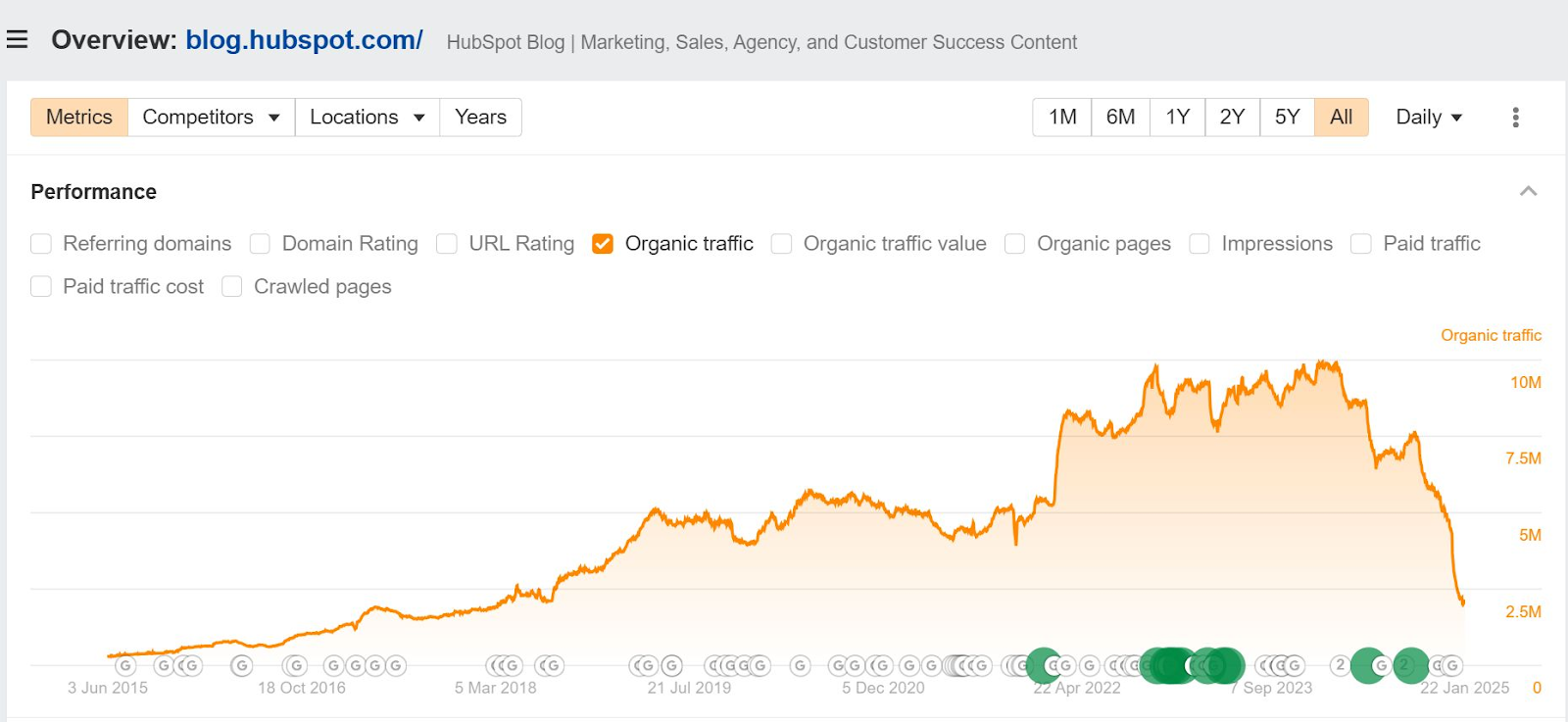
Check this screenshot (source) from Ryan Law. Hubspot, the absolute king of content, the coiners of the “inbound” term, are witnessing their organic traffic plummet from a peak 6M sessions to 800k.
There are many factors that contribute to this downfall of content.
And once you read it all, the conclusion is simple:
The days of having “easy-ish” #1 keywords are over. Google is not a reliable channel. We’ve known that for a long time. Any business that’s based on someone else’s business is aware that’s a liability. Other than that, nothing changes. Good content is a must-have. It’s just business. And sales. And relationships. And you need to have a voice, and communicate it effectively, and have some shit to say. The old black. The always black.
SEO will get harder but will still be there. Incentives are a very tricky thing, and you can rest assured that Google doesn’t want you to take your money elsewhere, so this will continue to change.
It’s not “the death of…” anything. It’s just ebbs and flows.
I firmly believe that for SMBs the only way to grow is through consistency. There’s only so much you can do at the same time. And technology can reach incredible velocity, but our ability to adopt and learn new tricks is limited. No more predictions. Just tips, hoping they’re useful for you this year:
Quick figures in case they can help as you jot numbers for the year:
Of course, if you need help making plans and setting priorities, you can consider our Blueprint service.
Life’s mostly irony and contradiction. And Norman Fucking Rockwell showed it masterfully.
What would his paintings look like today?

A recap and further development of what we think we can glimpse about the future of ecommerce, based on both short and long-term trends in the industry.

Notes about key marketing trends in early 2024, which of course, include AI and Taylor Swift. From "What's the "Big Idea?" with Salesforce's Martin Kihn.

What we do is about people. Our job will always be the human part of the job. Welcome to our fairly long issue about Generative AI, part 2.

The final issue of our series not about generative AI, but about people, the most extraordinary machine.


